
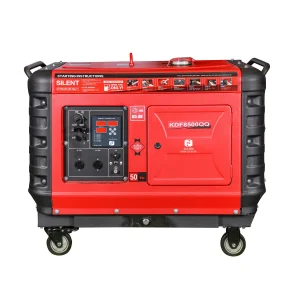
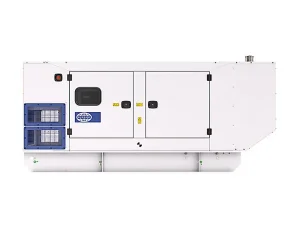
Super Silent · 6.9 - 7.5 kVA
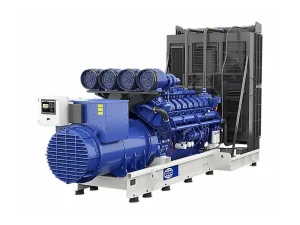
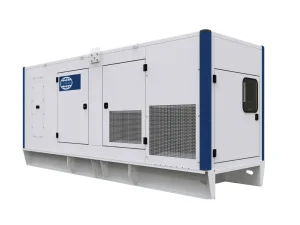
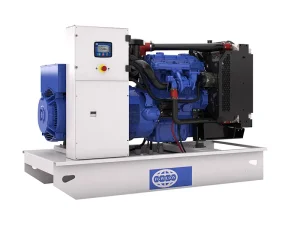
Explore our foundational range of heavy-duty and whisper-quiet power systems, engineered with genuine Perkins, Weichai, and Stamford configurations for global industrial operations.
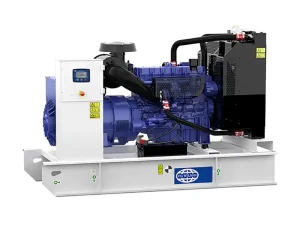
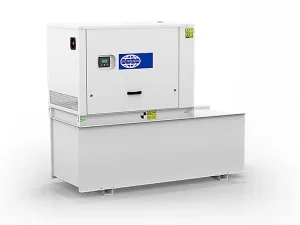
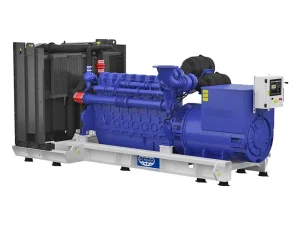
In modern industrial procurement, low acquisition cost must never compromise mean time between failures (MTBF), transient electrical performance, or regulatory emission thresholds.
Initial CapEx represents merely 12% to 18% of a commercial diesel generator set's full lifecycle cost. Operating expense (OpEx)—dictated by brake specific fuel consumption (BSFC, typically 195–215 g/kWh), lubrication replenishment intervals, and parasitic auxiliary loads—dominates 70%+ of overall expenditures over 20,000 operational hours.
A cost-effective genset must strictly meet ISO 8528-5 Class G2 or G3 standards. When inductive loads such as chillers or heavy electric submersible pumps engage, transient voltage dip must remain within 15% and recovery time under 1.5 seconds. Sub-standard alternators fail this benchmark, resulting in catastrophic plant automation resets.
Cost reduction achieved through low-grade cold-rolled non-grain-oriented (CRNGO) silicon steel in alternators causes severe total harmonic distortion (THD > 5%), frying delicate data center servers and PLC microchips. Our power assemblies feature Class H vacuum pressure impregnation (VPI) insulation ensuring THD < 3%.
Across industrialized territories and emerging resource corridors, the global diesel generator set market is undergoing a structural paradigm shift driven by grid fragility and rapid electrification.
The hyper-expansion of cloud computing hubs and high-density AI clusters demands instantaneous, uncompromising secondary prime power. Hyperscale facilities in Southeast Asia, the Middle East, and Latin America cannot tolerate even a 20-millisecond utility drop without automated transfer switch (ATS) failover. Multi-megawatt paralled generator arrays (such as the FG Wilson P1500-1 and P2500-1 configurations) ensure uninterrupted server continuity, isolated from volatile national grids.
Extractive industries in Sub-Saharan Africa, Australia, and Central Asia operate hundreds of kilometers beyond municipal grid perimeters. High-duty cycle open and weatherproof containerized diesel generator sets function as continuous island power stations. Heavy cyclic loading from crushers, ball mills, and conveyors requires engines configured with high displacement-to-power ratios, oversized cooling packages, and multi-stage fuel/water separation units.
| Operating Sector | Primary Power Need | Dominant Rating (ISO 8528) | Critical Sizing Parameters | Economic Risk of Outage |
|---|---|---|---|---|
| Tier-3/4 Data Centers | Continuous Emergency Standby | 1250 kVA – 2500 kVA (Parallel) | Sub-10s Start, G3 Transient, THD < 2.5% | $14,000 / minute of unplanned downtime |
| Healthcare Facilities | Life-Support Standby Power | 220 kVA – 938 kVA | NFPA 110 Type 10 ATS Integration, Sound < 68 dBA | Direct risk to patient life & life-support ops |
| Mining & Heavy Industry | 24/7 Prime Base Island Power | 500 kVA – 2000 kVA | High Ambient (50°C), Dual Heavy Air Filtration | Processing kiln freeze, $85,000 / occurrence |
| Commercial & Urban Retail | Peak Shaving / Emergency | 50 kVA – 330 kVA | Ultra-Silent Canopies, Compact Plant Footprint | Cold storage inventory degradation & retail loss |
How deep regional industrial clustering, vertically integrated component ecosystems, and high-throughput automated dyno testing deliver superior engineering at reduced capital expenditures.
Every genset leaves Beijing facilities with verifiable 0%, 25%, 50%, 75%, 100%, and 110% overload charts.
Direct SLA dispatch of Perkins, FG Wilson, and Weichai technical documentation and OEM components.
Direct manufacturer pricing achieved via cluster-based component sourcing without quality derating.
Our strategic presence in Beijing and coastal production hubs interfaces seamlessly with global OEM licensing partners (Perkins Engine Co., FG Wilson, and Weichai Power). This delivers economies of scale on precision cast engine blocks, Bosch high-pressure common rail (HPCR) systems, and Holset turbochargers.
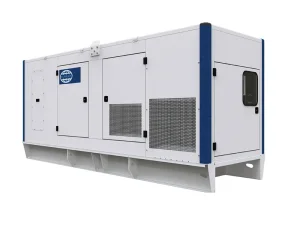
Acoustic canopies utilize robotic CNC laser-cut 2.0mm galvanized steel treated with high-adhesion electrostatic polyester powder coating. Marine-grade corrosion resistance (exceeding 1000-hour salt spray ASTM B117 testing) couples with flame-retardant sound-deadening foam to suppress sound to 65–72 dBA @ 7m.
Integration with DeepSea (DSE7320 / DSE8610) and Woodward controllers occurs in-house with automated schematic wiring harnesses. Comprehensive pre-configuration handles automatic load shedding, reverse power detection, vector surge relaying, and CANbus J1939 telematics before international crating.
A generator set rated at sea level and 25°C ambient will fail catastrophically if deployed without precise environmental engineering adaptations. We tailor thermodynamic profiles to your site conditions.
Standard cooling radiators saturate above 40°C. For Gulf and North African operations, we engineer heavy-duty 55°C ambient radiators featuring core thickness increments up to 30%, variable-speed belt ratios, anti-static non-sparking cooling fans, and cyclonic sand-trap louvers preventing abrasive silica intrusion.
Cold starting requires overcoming viscosity increases in API CI-4/CK-4 lubricants. Our Arctic package incorporates thermostatically controlled 240V jacket water immersion heaters, diesel fuel pre-heaters, heavy-duty AGM starting battery heat blankets, and motorized louvers that seal the canopy when stationary.
Thin atmospheric air reduces oxygen density, impairing complete stoichiometric combustion and causing heavy soot/derating. Our powertrain engineers match specific wastegate and variable-geometry turbochargers (VGT) to maintain prime output up to 3,000 meters altitude without de-rating penalties.
Coastal and offshore environments introduce high sodium concentrations. Alternators are upgraded with quadruple-dipped anti-corrosion windings, tropicalization varnish, sealed terminal boxes, and stainless steel (316 grade) door hinges, latches, and internal fasteners.
The internal combustion diesel engine is not static. Our engineering roadmap bridges mechanical thermodynamic efficiency with AI-driven energy optimization, hybrid battery microgrids, and alternative zero-carbon drop-in fuels.
Total compatibility across our entire Perkins and FG Wilson product line with 100% Hydrotreated Vegetable Oil (HVO / EN 15940) and synthetic drop-in fuels, slashing net lifecycle carbon emissions by up to 90% without injector degradation or warranty voids.
Pairing diesel gensets with Lithium Iron Phosphate (LiFePO4) Battery Energy Storage Systems. The genset runs strictly at its optimal fuel-efficiency island (70%–80% load factor), while the inverter absorbs instantaneous peak step-loads, avoiding wet stacking.
Edge-computed vibration spectroscopy and lubricating oil dielectric analysis transmitted via satellite/4G telemetry. Machine learning algorithms anticipate bearing wear, turbocharger seal clearances, and injector nozzle coking hundreds of hours prior to catastrophic failure.
Port-injection dual-fuel conversion packages enabling industrial diesel units to co-fire up to 40% hydrogen gas, providing high transient torque density alongside dramatic decreases in particulate matter (PM) and nitrous oxide (NOx) outputs.
Operating from Beijing with verified international compliance credentials, Beijing Xinda Creation Machinery Equipment Co., Ltd. backs every unit with transparent multi-tier quality assurance.
Certified Quality Management, Environmental Protection, and Occupational Health Systems. Every procedure—from steel welding, shot blasting, and harness routing to multi-point load cell testing—is documented with full tracing serial numbers.
Comprehensive standard coverage spans 12 months from the date of site commissioning or 1,000 running hours (whichever matures first). Global field-service kits, Perkins spare parts supply lines, and replacement fuel systems ship on priority express corridors.
Direct communication line with factory electrical and mechanical engineers. Receive sizing audits, ATS synchronizing schematics, exhaust backpressure calculations, and fuel circuit layout advice within one business day via phone, email, or WhatsApp.
From engine-driven welding generators and variable frequency sets to high-capacity industrial standby complexes, explore our complete export inventory.
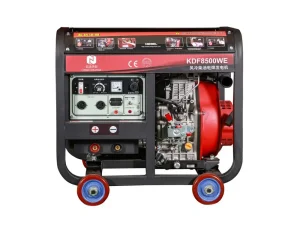
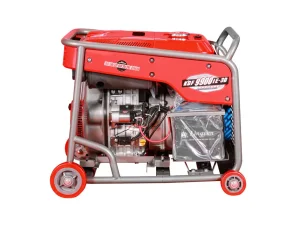
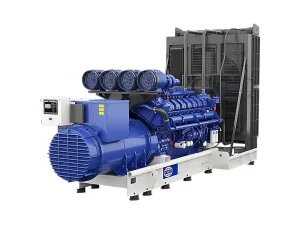
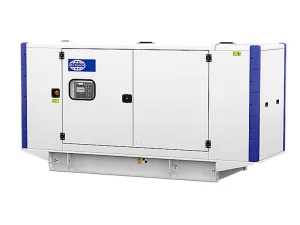
Direct technical responses addressing power factor calculation, low-load wet stacking, parallel synchronization, and international shipping logistics.
In standard AC electrical architectures, real power (kW) and apparent power (kVA) are linked via the power factor equation: kVA = kW / cos φ. For standard three-phase industrial diesel generators, standard alternating current alternators are rated at a power factor of 0.8 lagging. For example, a generator delivering 184 kW of real work produces 184 / 0.8 = 230 kVA apparent power.
However, when sizing for variable frequency drives (VFDs), thyristor-controlled industrial heaters, or high-surge induction motors (NEMA Code G to K across-the-line starting), locked-rotor kVA can surge 600% above nameplate running current. To prevent severe voltage collapse (>15%) and frequency deviation, our engineers calculate sub-transient reactance (X"d) parameters and ensure the alternator provides at least 300% short-circuit current capability for 10 seconds via permanent magnet generator (PMG) excitation.
Operating a diesel generator below 30% of its rated prime output for extended periods prevents cylinder pressures and combustion temperatures from reaching optimal operating points. This incomplete combustion allows unburned fuel and carbon particles to escape into the exhaust manifold, accumulating as a toxic, viscous black sludge known as "wet stacking."
This condition leads to cylinder bore glazing, turbocharger seal carbonization, and severe exhaust fire hazards. We mitigate this through automated microprocessor-governed load banks, intelligent sequential unit start/stop algorithms in multi-generator clusters, or by deploying smaller right-sized units (such as our 9.5 kVA to 55 kVA FG Wilson models) to handle nocturnal baseline loads while conserving the main heavy prime generation sets.
Emergency Standby Power (ESP): Maximum power available under variable electrical load conditions for the duration of a utility outage. No overload capability is permitted, and annual runtime should not exceed 200 hours at an average load factor of 70%.
Prime Power (PRP): Unlimited annual operating hours under variable load cycles. A 10% overload capability is available for 1 hour within every 12-hour operational window (compliant with ISO 3046/1). Average 24-hour load factor must not exceed 70% of prime rating.
Continuous Power (COP): Supplying power continuously to a 100% constant non-varying load for unlimited hours per year (base-load island utility). Selecting an ESP-rated unit for PRP or COP duty causes rapid thermal failure of the stator windings and invalidates factory warranties.
Paralleling two or more diesel generators (for example, pairing two 750 kVA P750-3 units instead of one large 1500 kVA system) offers superior N+1 redundancy, easier transport, and higher fuel efficiency during light-load shifts. For two generators to close onto a common busbar, their voltage magnitude, frequency, phase angle, and phase sequence must match exactly.
Our intelligent control systems (utilizing DeepSea 8610 or Woodward easygen-3000 controllers) continuously adjust electronic engine governors (via CANbus speed trim) and digital automatic voltage regulators (AVR droop/quadrature bias). The synchroscope closes the motorized circuit breaker within a tight window of ±5 degrees phase displacement, ±0.2 Hz frequency, and ±2% voltage deviation, followed by active kW and kVAr load balancing.
All diesel generator sets leaving our Beijing facilities are prepared in full compliance with international maritime breakbulk and containerized standards (ISPM 15 heat-treated fumigated wooden cradles or heavy-duty steel skid bases). Canopies are wrapped in multi-layer VCI (Vapor Corrosion Inhibitor) heat-shrink plastic shielding against marine salt fog.
All engine cooling circuits and lubrication lines are dry-flushed or loaded with anti-freeze preservation fluids. Procurement clients receive complete bill of lading (BL), certified factory dyno test reports, certificate of origin (CO / Form E / Form F for preferential tariffs), electrical schematic diagrams, and English language Perkins/FG Wilson operational & overhaul service manuals.