High-Efficiency Perkins & FG Wilson Generator Deployments
Explore field-tested open-skid and acoustic enclosed power generating units engineered for rigorous standby, prime, and continuous remote operations.
Global Industrial Landscape & Megawatt Scaling
Turbulent utility grids, decentralized energy paradigms, and rigorous green transition standards have repositioned high-speed industrial engines at the forefront of continuous power strategy.
Mission-Critical Continuity
Modern data centers and edge processing hubs demand steady-state output with near-zero voltage total harmonic distortion (THD). Perkins-driven prime systems step up instantaneously during grid dropouts, bridging the critical ramp gap to uninterruptible power units without thermal throttling.
Decentralized Energy Architecture
High-penetration renewable microgrids encounter chronic intermittency. Heavy-duty 4000 and 2000 series Perkins power generation engines operate as baseline stability nodes, capable of dynamically modulating their output against variable photovoltaic and wind influxes.
Lifecycle TCO Optimization
By optimizing the mean time between overhauls (MTBO) past 20,000 operational hours and delivering minimal brake specific fuel consumption (BSFC), these power architectures drastically reduce long-run operating overhead across twenty-year infrastructure spans.
Localization, Regulatory Compliance & Support Matrix
Operating a global power deployment entails strict alignment with local noise limits, tailpipe emissions standards, and comprehensive maintenance SLAs.
Emissions Harmonization
Configurations match Tier 2, Tier 3, and Stage V emissions caps via tailored electronic common rail (CRDI) management and aftertreatment architectures (DOC/DPF/SCR).
24-Hour Part Logistics
Instant access to authentic Perkins cylinder heads, injector nozzles, filtration cartridges, and overhaul kits across our networked overseas hubs mitigates costly field stoppages.
Acoustic Compliance
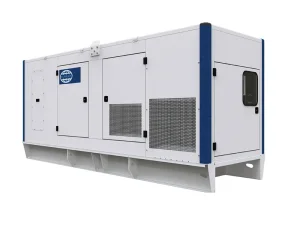
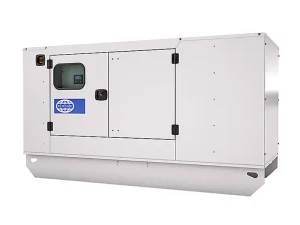
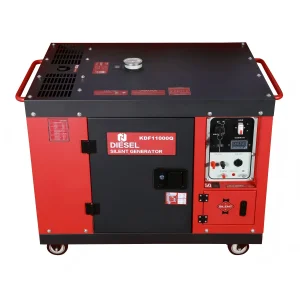
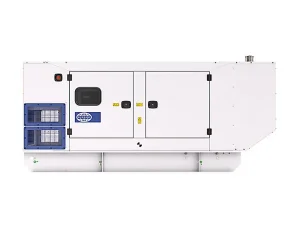
Super-silent canopy enclosures feature fire-retardant sound-absorbing foam and double-pass residential mufflers, dropping decibel curves below 68 dBA at 7 meters.
Quality Triple-Accreditation
Every manufacturing and packaging phase adheres to strict ISO 9001 (Quality), ISO 14001 (Environmental Management), and ISO 45001 (Occupational Safety) standards.
Severe Environment Engineering & Proven Footprints
Engineered to bypass the limits of standard off-the-shelf equipment, our Perkins-powered installations withstand corrosive humidity, sub-zero cold, and desert heat.
Equatorial & Desert Installations
Custom ambient-optimized cooling packages prevent power derating up to 50°C. Heavy-duty cyclonic air intake filters screen airborne sand and particulates, protecting cylinder liners and piston rings from abrasive scoring.
Long-Distance Energy Pipelines
High-reliability dual-fuel and diesel units support valve chambers, SCADA telemetry stations, and cathodic protection arrays along critical arteries, including the benchmark 2,400 km China-Myanmar crude oil pipeline corridor.
Arctic & High-Altitude Cold Starts
Engineered cold-weather packages integrate automated jacket-water heaters, fuel line glow plugs, and synthetic low-viscosity lubrication configurations, ensuring immediate ignition at -40°C in Arctic installations with zero cold-crank stalling.
Technical Roadmap: Decarbonization & Intelligent Management
The industrial combustion sector is entering a multi-fuel, sensor-dense era where digital telemetry and drop-in biofuels work side by side with traditional diesel platforms.
HVO & B100 Biofuel Compatibility
Current-generation Perkins prime configurations allow for 100% operation on Hydrotreated Vegetable Oil (HVO) and synthetic fuels conforming to EN 15940, immediately shedding up to 90% of net lifecycle greenhouse emissions without power derating.
AI Predictive Health Telemetry
Integrated edge CAN-bus controllers continually stream oil viscosity dynamics, vibration harmonics, crankcase pressure, and exhaust differential telemetry to cloud diagnostic layers, shifting operators from scheduled to predictive intervention.
Hybrid Synchronous Microgrids
Future setups natively incorporate direct solid-state relay interfaces, syncing diesel engine outputs with battery energy storage systems (BESS) for sub-cycle spinning reserve management during peak loads.
Engine Procurement & Engineering Considerations
Direct technical responses addressing system capacity calculations, enclosure choices, and long-term project support.
How do Prime (PRP) and Standby (ESP) ratings vary across Perkins engines?
Standby Power (ESP) is engineered for emergency outage response where power draw fluctuates, limiting average annual operation to 200 hours at variable loads without overload capability. Prime Power (PRP) permits continuous duty across an unlimited annual lifespan with an allowable 10% overload margin for 1 hour within every 12-hour duty cycle.
What is the standard methodology for sizing kVA against actual motor inductive loads?
Inductive devices (such as heavy pump motors and chillers) introduce high inrush currents upon direct-on-line (DOL) startup, drawing up to 6 times their running current. Sizing involves dividing the required running kW by the 0.8 power factor and scaling total capacity to limit transient voltage dips below 15% (per ISO 8528-G2/G3).
When should buyers choose an open-skid configuration over a soundproof canopy?
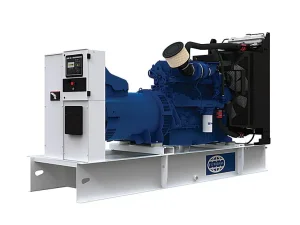
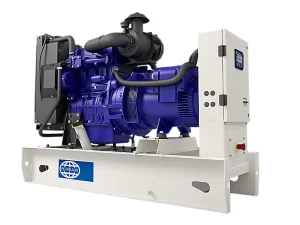
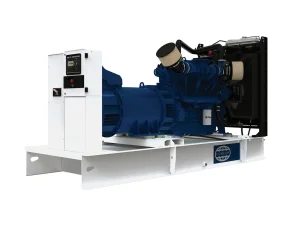
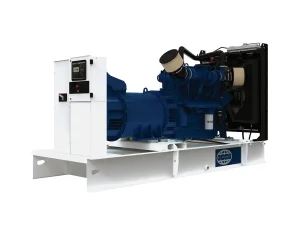
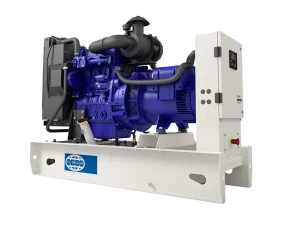
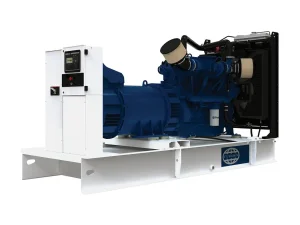
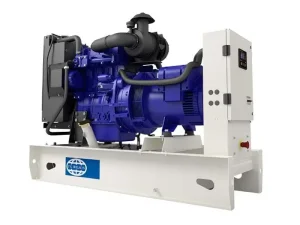
Open-skid gensets are designed for installation inside isolated equipment rooms with dedicated acoustic louvers and forced ducting, where equipment footprints and rapid access for cylinder inspections take priority. Acoustic enclosures are essential for external environments or hospital and commercial zones that require noise levels below 70 dBA.
How does altitude and extreme heat affect output derating curves?
Operating above 1,000 meters or in ambient temperatures beyond 40°C reduces air density, directly impacting turbocharger boost levels and combustion efficiency. Naturally aspirated and small turbocharged platforms typically derate by approximately 1% per 100 meters above 1,000 meters and 2% per 5°C increase over nominal ambient, requiring upsized engine displacements.
What warranty and parts availability accompany export-grade units?
Units carry a comprehensive 12-month baseline warranty effective from the date of site commissioning. Replacement parts, including filters, gasket kits, injectors, and controllers, are dispatched with full serial provenance via air freight within 24 hours to prevent extended downtimes.
What documentation is required to finalize an export-ready genset build?
Contractors need to provide site altitude, ambient temperature extremes, target voltage/frequency (e.g., 400V/50Hz vs 480V/60Hz), load step requirements, ATS logic preferences, and specific canopy emissions limits to generate build sheets and factory acceptance test protocols.
Heavy-Duty Generator Configurations & Commercial Units
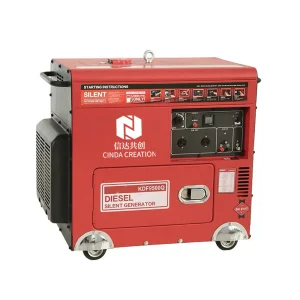
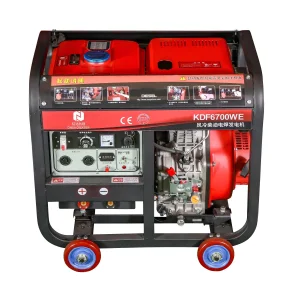
Explore our comprehensive lineup of commercial, industrial, and silent diesel generator configurations built for versatile worldwide applications.